It's 6:15 on a Tuesday evening. Every treadmill taken. Free weights area three-deep. A queue outside the studio. To anyone glancing at the CCTV, this looks like a thriving business.
But is it?
Across the UK fitness industry - independents, boutiques, multi-site chains - there's an assumption that's quietly doing damage. If the floor looks busy, the business must be healthy. If footfall is up, revenue follows. If members are walking through the door, they must be staying.
The evidence says otherwise.
The £7,000-a-month problem
In February 2026, the director of Gym 01 published an open letter on LinkedIn that got a lot of people talking. Monthly outgoings had risen by more than £7,000 every single month since early 2024. Not because of expansion. Not because of upgrades. Just rent, business rates, wages, National Insurance, utilities. Costs that are set to climb again this year.
This isn't one gym's story. It's the defining pressure on independent operators right now. The leisure sector has been overlooked for business rates relief while pubs and music venues benefit. Wages are rising faster than membership prices can absorb. And for operators without the data to know where their space is underperforming, the options are grim: price increases that risk churn, or margin collapse.
The irony? Many of these operators are sitting on 15–20% more capacity than they realise. Not new square footage - hidden in the hours, zones, and equipment rotations they're not measuring.
Footfall is visibility. It's not profitability.
A fitness industry professional shared something on LinkedIn recently that stuck with me. During his time in gym management, he believed one simple thing: if the gym is full, the business is doing well.
Every evening, the floor was packed. Treadmills full. Members waiting for machines. High energy. Looked successful.
Then he checked the numbers. Revenue was inconsistent. PT conversions were low. Renewals were weak. Despite heavy footfall, growth was flat.
His line was good: "Footfall is visibility. Retention and referrals are profitability."
A gym with 300 average daily check-ins but poor renewal culture will always struggle. A gym with 120 loyal members who renew, refer, and invest in coaching will generate predictable, scalable revenue. The difference isn't how many people walk through the door — it's what they do once they're inside, and whether the space is set up to serve them.
This is the data gap. Most gym operators can tell you how many members scanned in today. Very few can tell you which zones those members used, how long they stayed, whether they hit congestion, and whether that congestion correlated with cancellations the following month.
The expansion paradox
While independents battle rising costs, the big chains are pressing ahead. PureGym has confirmed new sites in London Dalston and Hounslow. The Gym Group has opened at White City Place and is rolling out HYROX group fitness across 120 locations nationwide.
This expansion raises a question that doesn't get asked often enough: how do you know if a new site is performing to its potential when you have no baseline for what "good" looks like?
Every new opening is a set of untested assumptions. Where should the functional training zone go? How much floor space does HYROX need relative to free weights? Is the studio large enough for peak-hour demand, or will it create a bottleneck that frustrates members in their first 90 days?
These decisions get made by experienced operators and architects using instinct, precedent, and floor plans. Instinct is valuable. But instinct can't tell you that your 6pm congestion in Zone C is driving 12% higher cancellation rates among new members. Only spatial data can.
The experience economy meets the evidence deficit
At the premium end, the conversation has shifted from capacity to experience. David Lloyd recently published member survey data and 72% say it brings positive balance to their lives.
Powerful numbers. David Lloyd has invested in new class formats - SPIRIT Pre and Post Natal, BATTLEBOX, holistic wellbeing classes - and is actively redesigning the member experience around wellness, not just fitness.
But there's a gap. That data is attitudinal - how members feel. What's missing is the behavioural layer - how members actually use the space. Are the BATTLEBOX sessions running at capacity or half-empty? Is the wellness studio cannibalising the yoga room or growing total facility usage? When you invest in new programming, how do you know the space allocation matches demand?
For most operators, the answer is: they don't. They survey satisfaction. They track bookings. They don't measure what happens on the floor between the scan-in and the exit.
The council contract challenge
The pressure for evidence isn't just internal. It's being demanded by local authorities.
Everyone Active recently secured a 10-year contract with Ealing Council to manage leisure centres across the borough. A deal of that duration requires ongoing demonstration of facility performance, community access, and operational efficiency. Councils aren't satisfied with anecdotal reports anymore. They want data: who is using these facilities, when, and how effectively.
This is accelerating across public leisure. Operators who can provide real-time evidence of utilisation, access patterns, and community impact will win contracts. Those who can't will find themselves undercut by competitors who can.
The missing layer
The fitness technology market isn't short of software. Gym management platforms offer membership tracking, booking systems, dashboards. Access control counts who walks in. Class booking tracks who signs up.
None of them answer the fundamental question: what is actually happening inside the space?
This is the missing layer. Between the moment a member taps their card and the moment they leave, there's a physical journey through your facility that generates no data. Which zones did they visit? How long did they dwell in each? Did they encounter congestion? Did they use the equipment you invested in? Did the layout guide them to high-value areas, or did they default to the same three machines every session?
Your gym management system tells you what happened to your business. Spatial intelligence tells you why.
What the smartest operators are starting to do
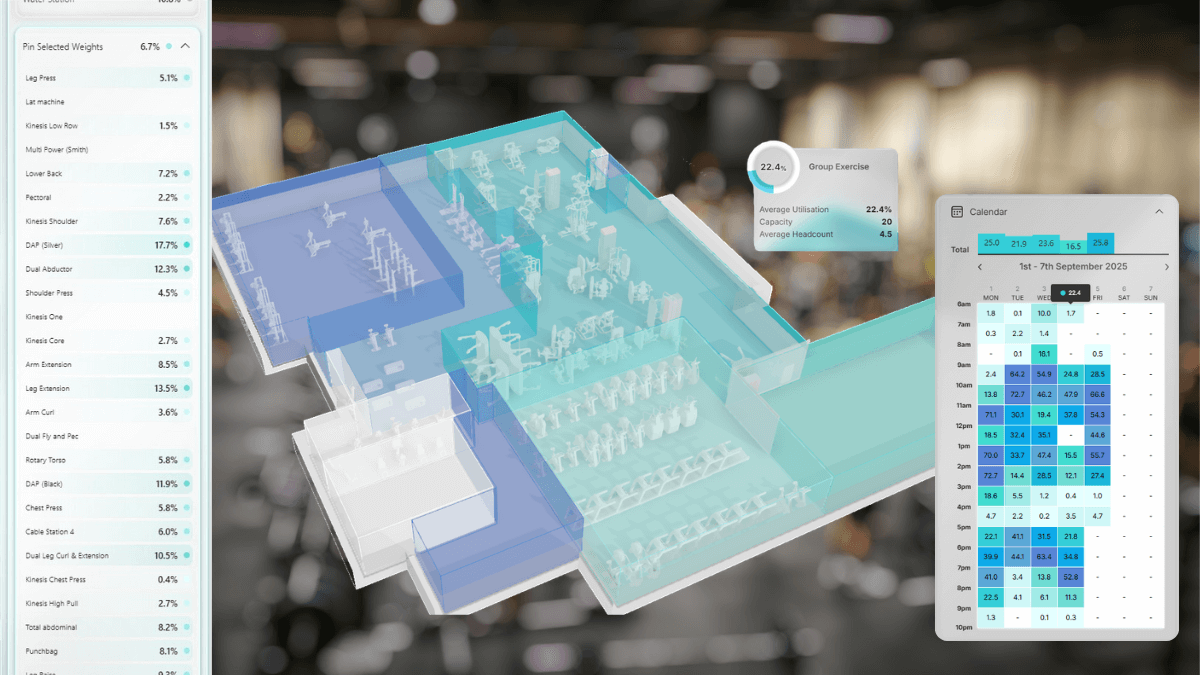
A new category of operational intelligence is emerging. AI-powered digital twins - virtual replicas of physical spaces, fed by real-time and historical data - are giving operators visibility at a level of detail that simply wasn't possible before.
Zone-level occupancy. Heatmaps. Equipment utilisation rates. Congestion prediction.
For multi-site operators, this means benchmarking zone performance across dozens or hundreds of locations. Which sites are running their functional training areas at capacity? Which are underusing their studios? Where is HYROX working, and where does it need intervention?
For independents facing the £7,000-a-month squeeze, it means finding revenue in existing space. Identifying off-peak hours where targeted promotions could fill dead zones. Understanding which equipment is over-provisioned and which is creating queues.
For leisure centres managing council contracts, it means automated performance reporting that demonstrates community impact and access equity without manual data collection.
For premium clubs investing in experience, it means bridging the gap between how members say they feel and how they actually behave.
The question every operator should be asking
Costs are rising. Expansion is continuing. Experience expectations are climbing. Council contracts demand evidence. And the gap between what operators see and what they know has never been wider.
The packed floor is not enough. The scan-in count is not enough. The booking dashboard is not enough.
The question isn't whether your gym looks busy. It's whether your space is working as hard as your team is. And the only way to answer that is with data from where it matters most - the floor itself.
Your gym dashboard shows what's happening to your business. A digital twin shows why it's happening in your space.
If that sounds interesting, we should talk.